Practical help, from knowledge that is free to read.
Everyday Open is an umbrella for practical apps that turn free, trusted knowledge into help a person can use. The help is open, cited and written in plain English, and it is privacy-first: no adverts, and no selling of data. The apps are built with AI assistance and human review. This site is the front door and a portfolio: the first app is in preview, and the rest are only planned.
Manifesto
Draft 4, in its own words. Section headings are in sentence case; the plain-text file sets them in capitals. Principle lines are unchanged, including the full stop. The draft still calls Essex Garden planned. The preview is newer, and that sentence is left as written. Read it on its own page. The plain text is MANIFESTO.txt.
OPEN KNOWLEDGE, PUT TO WORK
An umbrella manifesto (draft 4, for the community to tear up and rewrite)
Why
Human knowledge is mostly free to read but hard to use. AI can help close that gap by turning trusted knowledge into practical help that helps people do more. We want that help to be free of cost, adverts and surveillance, and owned by the people who use it.
Using AI has a real water, energy and carbon cost. We treat that cost as a design constraint, not a rounding error: we measure it, we cut it first, and we only then fund credible restoration or efficiency work for what is left. We do not pretend a credit makes the use disappear.
What this is
An umbrella for community-led projects that share one set of principles. Each project solves a concrete problem. Together they share standards, tools and lessons, so that every new project starts further ahead than the last.
Projects under the umbrella
Projects are added as the community proposes and builds them. A project joins when it adopts these principles and has a working first version. The umbrella must not grow faster than its projects actually work.
- First candidate (not yet a member): How to look after an Essex garden, a books-to-tasks website, being planned. It will turn trusted public-domain books into sourced, personalised tasks, with a full-text reader and on-device data by default, and it will link back here.
- Future examples: offline tutors, practical skills guides, home and energy planning, repair guides, and civic and political understanding.
Principles (shared by every project)
1. Open source, always.
Code, prompts, rules and data formats are published under open licences. Anyone can inspect, fork or self-host.
2. No adverts. No selling data.
User data stays on the user's own device. Nothing leaves it unless the user chooses to share, and they can see exactly what would go.
3. Free to use, honest about cost.
AI isn't free to run, so we're open about who pays. By default it runs on small open models on the user's own device. Optional extras are clearly labelled: bring your own API key, or use donation-funded hosting that is charged at cost and has published accounts.
4. Point to what already works.
If Wikipedia, Khan Academy, Kiwix, official guidance or another open project already does it well, we link to it or build on it rather than rebuild it.
5. Every claim shows its source.
Outputs link back to where they came from. If we can't cite it, we don't present it as fact.
6. Safety before convenience.
Anything that could cause harm carries a warning. Outdated advice is flagged as "Old advice" with a link to current guidance. Advice we can't verify is marked "Unverified", and the "Just do" mode is switched off for it.
7. Learn at your own depth.
Wherever there's something to learn, users choose how they engage:
- Just do: clear steps, ready to follow.
- Do while learning: the steps, plus the why.
- Just learn: the knowledge itself, without the task.
8. Accessible by default, consistent everywhere.
Every project uses the same accessibility settings and meets WCAG 2.2 AA as a minimum. The community suggests improvements and tests them with real users.
9. Respect creators.
We only use material we have the right to use. Sources are credited and linked.
10. Every change is traceable.
Every edit records who made it, when, why, its source and exactly what changed, and it can be undone. Safety-critical edits need two reviewers. Disagreements are recorded openly, not hidden.
11. Governed in the open.
Decisions follow a written process that anyone can read and challenge. Founders don't get the final say forever; authority passes to the community as it grows.
12. Reduce first. Offset only what remains, and never greenwash.
We estimate and publish the water, energy and carbon used to build and run each project, with the method and the uncertainty. We avoid unnecessary model use, prefer small, efficient and local models and short context, and only then fund credible, place-specific restoration or efficiency work. Offsetting water is weaker than using less, and a litre "replaced" in one catchment does not cancel a litre consumed in another. We never claim to be water-neutral or carbon-neutral on the back of weak credits.
What the umbrella provides
- These shared principles, and a simple way to check a project meets them.
- Shared building blocks: accessibility settings, the three learning modes, safety warnings, source citation and traceable edits.
- A shared way of working, including the multi-bot development framework (vibecodebots), so that small teams can build to a high standard.
- A shared method for estimating, reducing and reporting the water, energy and carbon of AI use, and for choosing any later offsets (SUSTAINABILITY.txt).
- A place to propose projects, find contributors and learn from other projects' mistakes.
How we'll know it's working
- People use what we make to actually do things they couldn't do before.
- No unsafe instruction ever reaches someone in "Just do" mode.
- Everything runs on cheap, older devices, including offline.
- New projects reuse shared parts instead of starting from scratch.
- People choose to contribute without being paid.
- Each project publishes its estimated water, energy and carbon, with method and uncertainty; those estimates fall over time per unit of useful work; offsets are listed separately and are never used to net a headline to zero.
What we won't do
- Grow by advertising, tracking or engagement tricks.
- Present AI output as settled truth.
- Let the umbrella grow faster than its projects actually work.
- Claim water or carbon neutrality, or "offset AI", on the basis of credits that are not additional, verified and like-for-like.
- Let buying offsets replace cutting use.
This is a first pass. It will change. That's the point.
Work
Portfolio
Essex Garden
In preview Not a public release. Not a member of the umbrella. PROJECTS.txt still lists it as a candidate.
Essex Garden is the first candidate. It turns public-domain gardening books into tasks for an Essex plot, and the cited book can be read in full on the same site. It is not a member yet.
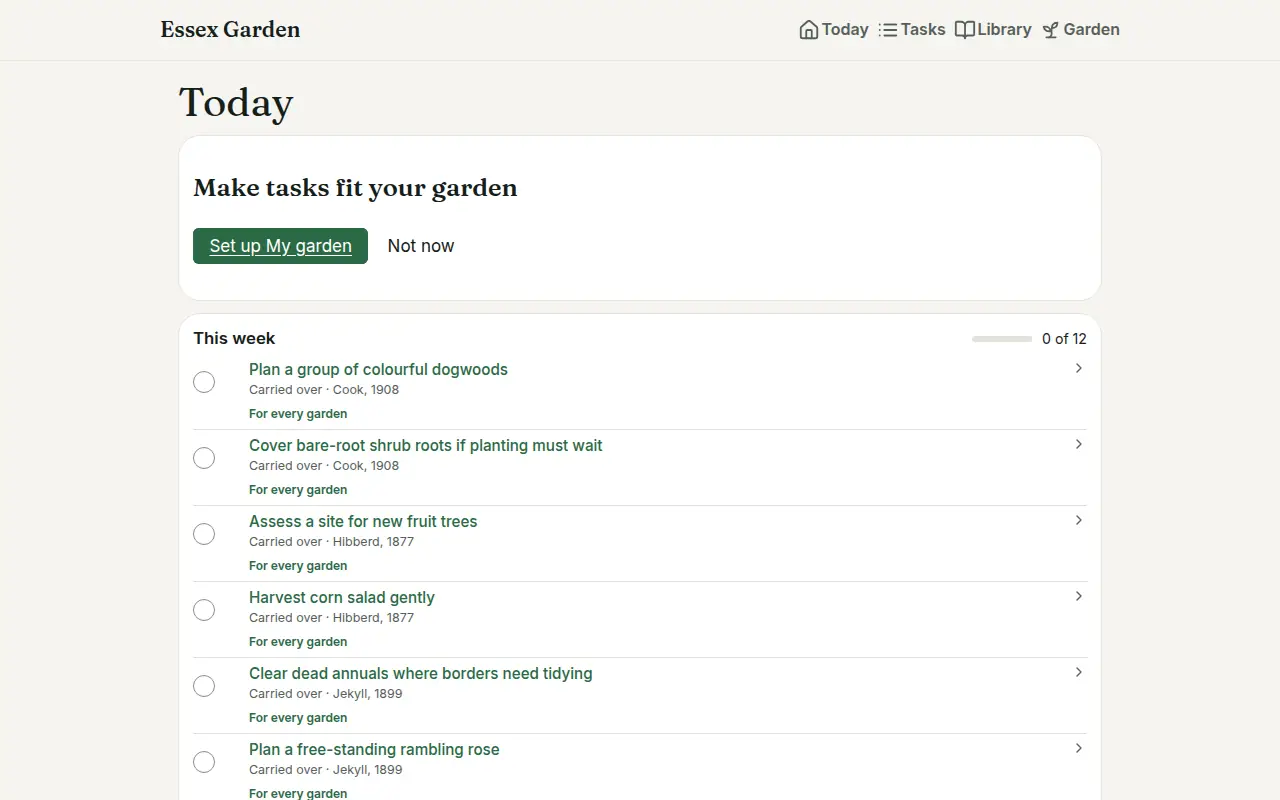
These notes are from the public site and the public repository on 16 November 2026, not from a private brief. The public pages say there is no account required, no adverts and no tracking. Membership has not been recorded. A candidate joins only after it has adopted the shared principles and has a working first version, and that acceptance is a written decision.
- The Today page lists weekly tasks. Each one names a book and a year.
- The library page says it holds 14 public-domain gardening books. It also says one book is uncorrected scanned text.
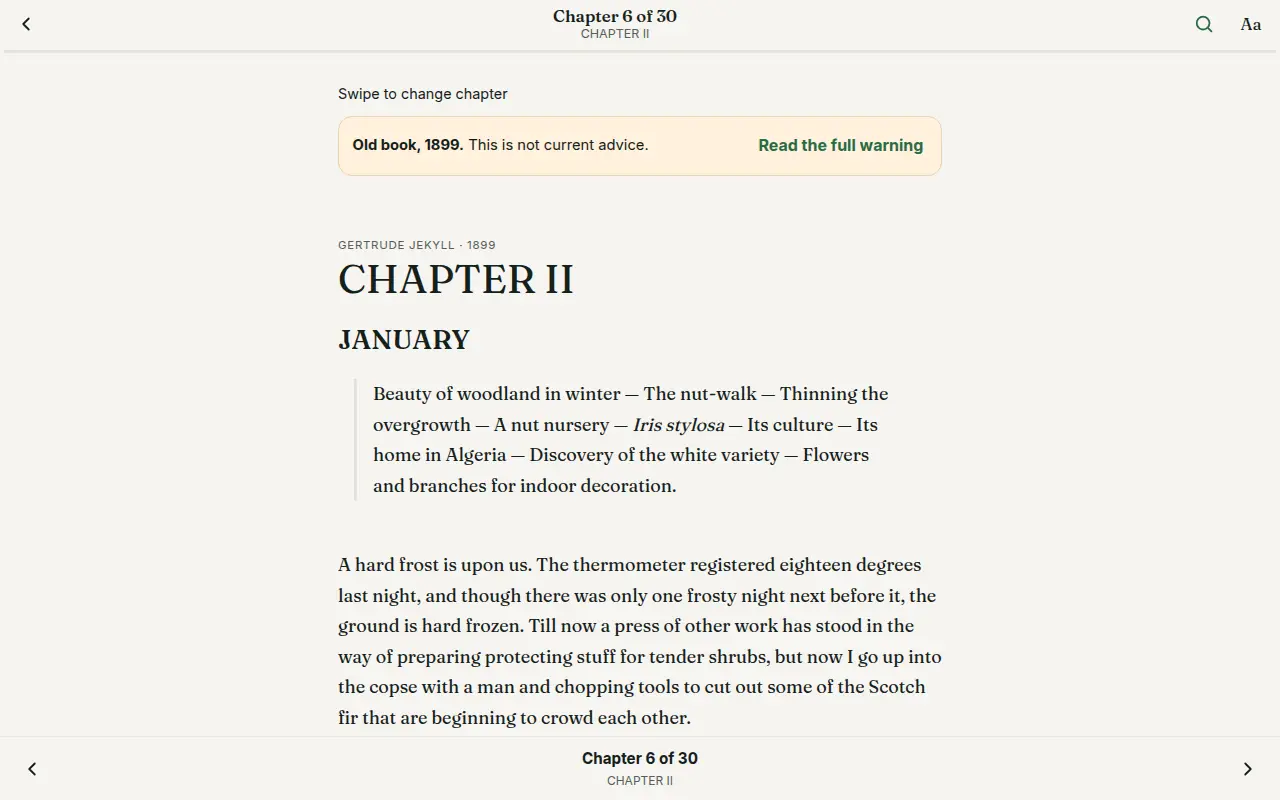
- A chapter page carries a notice that the book is old and is not current advice. The tasks page says the tips are drafts and not yet checked by a horticulturist.
- The same Today page has a dark colour setting and a layout for a narrow screen.
Principles it is starting to show
This is not a claim that every principle is met. It is what a reader can check today.
- Open source (principle 1). Code and documents are in the public repository.
- No adverts and no selling of data (principle 2). The library page says no account, no adverts and no tracking. The homepage markup fetched the same day linked only to files on essexgardening.uk.
- Every claim shows its source (principle 5). Tasks name a book and a year.
- Safety before convenience (principle 6). Old books are marked as old, and the tasks are marked as drafts.
- Accessible by default (principle 8). The axe count below. Automated scans are only part of that principle.
- Every change is traceable (principle 10). The decision log and the commit history are public.
Evidence
- Commits
- 44 commits on main, counted from the GitHub commits API on 16 November 2026. The tip was 007f584. Commit list.
- Decisions
- 214 decision records in the November 2026 log. Identifiers run from DEC-2026-0001 to DEC-2026-0215. DEC-2026-0170 is not in the file. Decision log at that commit.
- Accessibility
- 84 axe-core scans in the report timestamped 2026-11-16T12:04:31.202Z: 28 addresses, each in light, dark and high contrast, and every line says no violations. This is an automated scan, not a finished human audit. Axe report at that commit.
The live preview is at https://essexgardening.uk/. It asks search engines not to index it. Treat it as a preview.
The full case study, with the library, the phone layout and dark colours.
Planned
Three further apps are named, and only named. They were set down for this site on 16 November 2026. They are not in PROJECTS.txt. They have no repository and no working version. They are not members. The registry that day listed one candidate: Essex Garden.
Planned
Energy saving at home
Not started. No repository.
Planned
Sewing and mending
Not started. No repository.
Planned
Birdwatching and wildlife recording
Not started. No repository.
How we work
Small projects, written down. The order is the same each time.
- Build. A person, often with an AI assistant, makes a working version in the open. The shared framework is vibecodebots.
- Persona reviews. The draft is read as if by different kinds of reader. The notes are kept.
- One fix pass. The draft is changed once for those notes.
- An owner decision log. A choice that matters is written down: what was decided, the options, who decided, when, why, and whether it can be undone. A bot may draft. It does not approve membership, change the manifesto, or spend money.
- Code and security review is a release gate. The work is not treated as released until that review is done. This site is behind that gate. It asks search engines not to index it until Jon Marson releases it.
- Sources. A claim about a standard, a law, a paper or an official figure cites a source, with the date it was checked. A missing number stays blank. The list is docs/sources.txt.
Get involved
The intended mailbox is privacy@everydayopen.org. It is not live yet. Please do not send personal information to it until the owner says it is open.
Until then, use the repositories:
- This umbrella: https://github.com/jonmarson-cmd/everyday-open
- Essex Garden: https://github.com/jonmarson-cmd/EssexGardening
- The build framework: https://github.com/jonmarson-cmd/vibecodebots
How to propose a change is in CONTRIBUTING.txt. Conduct is in CODE_OF_CONDUCT.txt. To report a conduct concern, use the method in that file: the repository owner, via the contact details on the GitHub profile, or GitHub's report feature. Do not post the details of an incident in a public issue.
Founder: Jon Marson, github.com/jonmarson-cmd.